
The introduction of IFRS 16 lease accounting requires lessees to recognize almost all leases on the balance sheet, and the standard eliminates the old distinction between operating and finance leases for lessees, ensuring that financial statements faithfully represent the economic reality of leasing transactions.
Whether you are a financial controller, an auditor, or an accounting student, mastering IFRS 16 lease accounting is essential. This comprehensive, step-by-step guide will walk you through the core principles of calculating a lease liability, with practical examples to make the process clear, simple, and easy to understand.
If you would want a more simplified accounting approach for small and medium enterprises, you can also read this article about IFRS for SMEs.
Understanding the Basics of IFRS 16 Lease Accounting
Under IFRS 16 lease accounting, an entity must first assess whether a contract is, or contains, a lease at its inception. A contract contains a lease if it conveys the right to control the use of an identified asset for a period of time in exchange for consideration. To control the use of the asset, the customer must have both the right to obtain substantially all of the economic benefits from its use and the right to direct how and for what purpose the asset is used.
When a lease is identified, a lessee is required to recognize two key elements on the commencement date:
1. A Right-of-Use (ROU) Asset
Representing the lessee’s right to use the underlying asset over the lease term.
2. A Lease Liability
Representing the obligation to make lease payments.
The Exemptions
Before diving into calculations, it is important to note that IFRS 16 lease accounting offers two practical recognition exemptions where a lessee can choose not to recognize an ROU asset and lease liability:
- Short-term leases: Leases that, at the commencement date, have a lease term of 12 months or less and do not contain a purchase option.
- Leases of low-value assets: This assessment is based on the asset’s absolute value when new, regardless of the lessee’s size or materiality thresholds (e.g., tablets, personal computers, small office furniture, and telephones).
If an entity elects to use these exemptions, the lease payments are recognized simply as an expense on a straight-line basis over the lease term, or another systematic basis if more representative.
Step 1: Determine the Lease Term
The first crucial step in calculating the lease liability is determining the correct lease term. Under IFRS 16 lease accounting, the lease term is the non-cancellable period of a lease, plus:
- Periods covered by an option to extend the lease if the lessee is reasonably certain to exercise that option.
- Periods covered by an option to terminate the lease if the lessee is reasonably certain not to exercise that option.
To determine whether exercising an option is reasonably certain, the entity must consider all relevant facts and circumstances that create an economic incentive to do so. Examples of factors to consider include:
- Contractual terms compared to market rates (e.g., is the extension rent significantly below market value?).
- Significant leasehold improvements undertaken by the lessee that will have significant economic benefit when the option becomes exercisable.
- Costs relating to termination, such as relocation costs or penalties.
- The importance of the underlying asset to the lessee’s operations, especially if it is highly specialized.
Step 2: Identify the Lease Payments
Under IFRS 16 lease accounting, once the lease term is locked in, you must identify which payments are included in the initial measurement of the lease liability. At the commencement date, the lease liability is measured at the present value of unpaid lease payments.
The lease payments included in the calculation comprise:
- Fixed payments (including in-substance fixed payments), less any lease incentives receivable. In-substance fixed payments are payments structured as variable, but that are, in reality, unavoidable.
- Variable lease payments that depend on an index or a rate (e.g., payments linked to a consumer price index or a benchmark interest rate like LIBOR). These are initially measured using the index or rate exactly as it stands at the commencement date.
- Amounts expected to be payable under residual value guarantees.
- The exercise price of a purchase option, provided the lessee is reasonably certain to exercise it.
- Payments of penalties for terminating the lease if the lease term reflects the lessee’s exercise of an option to terminate.
Important Note on Variable Payments: Variable lease payments that are linked to future performance or usage (such as a percentage of retail sales) are excluded from the lease liability. Instead, these are recognized as an expense in profit or loss in the period the triggering event occurs.
Step 3: Determine the Discount Rate
To calculate the present value of the identified lease payments, you need an appropriate discount rate. IFRS 16 lease accounting dictates a strict hierarchy for this:
- The interest rate implicit in the lease: This is the rate that sets the present value of the lease payments and the unguaranteed residual value equal to the fair value of the underlying asset plus initial direct costs. If this rate can be readily determined, it must be used.
- The lessee’s incremental borrowing rate: If the implicit rate cannot be readily determined, the lessee must use their incremental borrowing rate. This is defined as the interest rate the lessee would have to pay to borrow funds over a similar term, with similar security, to obtain an asset of similar value in a similar economic environment.
Step 4: Calculate the Initial Lease Liability and ROU Asset
Practical Example 1: Initial Measurement
Let’s walk through a practical scenario to bring IFRS 16 lease accounting to life.
The Scenario:
- Asset: A specialized piece of manufacturing equipment.
- Lease Term: 5 years (non-cancellable, no extension options).
- Lease Payments: $25,000 per year, payable at the end of each year.
- Discount Rate: The implicit rate cannot be readily determined, so the lessee uses their incremental borrowing rate of 6%.
- Initial Direct Costs: The lessee pays $2,000 in legal and arrangement fees to secure the lease.
- Incentives: The lessor provided a $1,000 cash incentive at the start of the lease.
Calculating the Lease Liability: The lease liability is the present value of the five $25,000 payments discounted at 6%. Using the standard present value of an ordinary annuity formula, the calculation is:
- Year 1: $25,000 / (1.06)^1 = $23,584.91
- Year 2: $25,000 / (1.06)^2 = $22,249.91
- Year 3: $25,000 / (1.06)^3 = $20,990.48
- Year 4: $25,000 / (1.06)^4 = $19,802.34
- Year 5: $25,000 / (1.06)^5 = $18,681.45
- Total Initial Lease Liability = $105,309.09
Calculating the Right-of-Use (ROU) Asset: The ROU asset is not always perfectly equal to the lease liability. At the commencement date, a lessee measures the ROU asset at cost, which comprises:
- The initial measurement of the lease liability ($105,309.09).
- Plus any lease payments made at or before commencement (None in this example).
- Less any lease incentives received ($1,000).
- Plus any initial direct costs incurred by the lessee ($2,000).
- Plus an estimate of costs to dismantle or restore the asset (None in this example).
- Total Initial ROU Asset = $105,309.09 – $1,000 + 106,309.09*
At commencement, the lessee records a debit to the ROU Asset for $106,309.09, a credit to the Lease Liability for $105,309.09, and a net credit to Cash for $1,000 (reflecting the $2,000 paid minus the $1,000 incentive received).
Step 5: Subsequent Measurement of the Lease Liability
After the commencement date, IFRS 16 lease accounting requires the lessee to measure the lease liability by:
- Increasing the carrying amount to reflect interest on the lease liability.
- Reducing the carrying amount to reflect the lease payments made.
The interest on the lease liability in each period must be the amount that yields a constant periodic interest rate on the liability’s remaining balance. This interest expense is recognized in profit or loss (unless capitalized as part of another asset under other standards).
Concurrently, the ROU asset is measured applying a cost model (unless the entity applies specific revaluation or fair value models allowed under IAS 16 or IAS 40). Under the cost model, the ROU asset is depreciated over the shorter of the lease term or the underlying asset’s useful life.
Practical Example 2: The Amortization Schedule
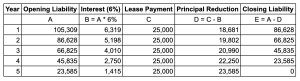
Continuing from Example 1, let’s look at how the lease liability of $105,309.09 amortizes over the 5-year term at a 6% discount rate.
Year 1:
- Opening Balance: $105,309.09
- Interest Expense (6%): $105,309.09 × 6% = $6,318.55
- Lease Payment: $25,000.00
- Principal Reduction: $25,000.00 – $6,318.55 = $18,681.45
- Closing Liability Balance: $105,309.09 – 86,627.64
In Year 1, the entity will recognize interest expense of $6,318.55 in the statement of profit or loss and classify the $18,681.45 principal payment under financing activities in the statement of cash flows.
Year 2:
- Opening Balance: $86,627.64
- Interest Expense (6%): $86,627.64 × 6% = $5,197.66
- Lease Payment: $25,000.00
- Principal Reduction: $25,000.00 – $5,197.66 = $19,802.34
- Closing Liability Balance: $86,627.64 – 66,825.30
Year 3:
- Opening Balance: $66,825.30
- Interest Expense (6%): $66,825.30 × 6% = $4,009.52
- Lease Payment: $25,000.00
- Principal Reduction: $25,000.00 – $4,009.52 = $20,990.48
- Closing Liability Balance: $66,825.30 – 45,834.82
Year 4:
- Opening Balance: $45,834.82
- Interest Expense (6%): $45,834.82 × 6% = $2,750.09
- Lease Payment: $25,000.00
- Principal Reduction: $25,000.00 – $2,750.09 = $22,249.91
- Closing Liability Balance: $45,834.82 – 23,584.91
Year 5:
- Opening Balance: $23,584.91
- Interest Expense (6%): $23,584.91 × 6% = $1,415.09
- Lease Payment: $25,000.00
- Principal Reduction: $25,000.00 – $1,415.09 = $23,584.91
- Closing Liability Balance: $23,584.91 – 0.00**
As shown, the liability smoothly zeroes out by the end of the lease term. At the same time, the ROU asset (initially $106,309.09) would typically be depreciated on a straight-line basis by 106,309.09 / 5 years).
Lease Reassessments
In the real world, leases rarely stay static. IFRS 16 lease accounting provides strict rules for handling changes in lease payments after the commencement date.
Reassessment of the Lease Liability
A lessee must remeasure the lease liability if there is a change in the lease payments. When remeasuring, the amount of the remeasurement is generally recognized as an adjustment to the ROU asset. (If the ROU asset is reduced to zero, any further reduction in the liability is recognized in profit or loss).
You must remeasure the liability using a revised discount rate if:
- There is a change in the lease term (e.g., the lessee decides to exercise an extension option they previously were not reasonably certain to exercise).
- There is a change in the assessment of an option to purchase the underlying asset.
You must remeasure the liability using an unchanged discount rate (unless the change is due to floating interest rates) if:
- There is a change in the amounts expected to be payable under a residual value guarantee.
- There is a change in future lease payments resulting from a change in an index or a rate (such as a CPI adjustment or a market rent review). The liability is only remeasured when the cash flows actually change.
Lease Modifications
As per IFRS 16 lease accounting, lease modification is a change in the scope of a lease or in the consideration for a lease that was not part of the original terms and conditions.
A modification is accounted for as a completely separate new lease if both of the following apply:
- The modification increases the lease’s scope by adding the right to use one or more underlying assets.
- The consideration increases by an amount commensurate with the stand-alone price for the increase in scope.
If the modification is not accounted for as a separate lease, on the effective date of the modification the lessee must determine the lease term of the modified lease and remeasure the lease liability by discounting the revised payments at a revised discount rate.
For modifications that decrease the scope of the lease (e.g., reducing the rented square footage), the lessee decreases the ROU asset to reflect the partial or full termination and recognizes any resulting gain or loss in profit or loss. For all other modifications, the lessee simply makes a corresponding adjustment to the ROU asset.
Conclusion
Mastering IFRS 16 lease accounting requires a diligent, structured approach, from accurately identifying lease terms and gathering payment data to applying the correct discount rates and monitoring ongoing modifications.
Navigating these requirements can be complex, but you don’t have to do it alone. Whether you need assistance setting up a compliant lease accounting system or revising your chart of accounts, I am here to help. Contact me today to ensure your business stays fully compliant and audit-ready in tune with IFRS 16 lease accounting and other applicable standards.