The IFRS for SMEs standard is a globally recognized, self-contained financial reporting framework explicitly designed for entities that publish general-purpose financial statements for external users but inherently lack public accountability. In order to properly apply the standard, we should know the scope aka applicability, of IFRS for SMEs.
Under the framework, public accountability is triggered by two definitive conditions. First, an entity is publicly accountable if its debt or equity instruments are actively traded in a public market. This includes domestic and foreign stock exchanges, as well as over-the-counter markets. Furthermore, an entity is immediately disqualified from using the IFRS for SMEs standard if it is currently in the process of filing with a securities commission to issue any class of instruments in a public capacity.
Second, the standard aggressively restricts the implementation of IFRS for SMEs to entities whose primary business model is holding assets in a fiduciary capacity for outsiders. This stops banks, credit unions, insurance companies, securities brokers, mutual funds, and investment banks from adopting IFRS for SMEs. Because insurers and banks manage funds directly for the public, their risk profiles require full disclosure under IFRS.
However, a mid-market entity does not cross the public accountability threshold simply because it issues private debt to institutional investors, private equity firms, or venture capital. The restriction is strictly linked to public market trading. Therefore, high-growth SMEs operating with heavily leveraged balance sheets via private credit can entirely legally leverage the streamlined reporting of the IFRS for SMEs framework.
Nevertheless, execution risks arise when a private entity begins preparing for a structural exit or an Initial Public Offering (IPO). Because the threshold includes entities ‘in the process of issuing’ public instruments, management must complete a full transition to full IFRS before the IPO filing.
Disclosure Comparison (IFRS for SMEs vs. Full IFRS)
The architecture of the IFRS for SMEs is driven by a mandate to reduce the administrative burden on preparers while maintaining transparency for lenders and non-managing owners. To achieve this, the International Accounting Standards Board (IASB) condensed the 2,800-page Full IFRS framework into a self-contained document of roughly 250 pages.
Absolute omission of (Earnings Per Share, Segment Reporting, Interim Reporting)
The most profound change is the complete omission of reporting modules that specifically served public interest. The IFRS for SMEs standard completely eliminates the requirement to calculate and present Earnings Per Share (EPS). Similarly, it entirely omits the burdensome requirements of Segment Reporting and Interim Financial Reporting. If an SME management team voluntarily chooses to disclose segment data or interim reports, they are only required to describe their basis for preparation and are strictly exempt from applying the exhaustive methodologies mandated by Full IFRS. Assets held for sale also do not require the complex separate presentation and measurement required by IFRS 5.
Analysis of the 90%+ reduction in disclosure criteria and cost-benefit optimization
The framework brings a roughly 90% reduction in disclosure volume. The IASB executed this reduction by anchoring the standard in the principle of ‘undue cost or effort’, an exemption applied pervasively to excuse SMEs from complex fair value measurements if the calculation cost heavily outweighs the analytical benefit to the user.
|
Reporting Module
|
Full IFRS Requirement
|
IFRS for SMEs Standard Treatment
|
|---|---|---|
|
Earnings Per Share
|
Mandatory complex calculation (Basic & Diluted).
|
Absolutely omitted; no presentation required.
|
|
Segment Reporting
|
Mandatory quantitative operating segment breakdowns.
|
Absolutely omitted.
|
|
Interim Reporting
|
Prescriptive quarterly/half-year reporting rules (IAS 34).
|
Absolutely omitted.
|
|
Assets Held for Sale
|
Separate presentation and specific measurement (IFRS 5).
|
No separate classification; treated as an impairment trigger.
|
|
Fair Value Option
|
Available across numerous asset/liability classes.
|
Strictly limited; heavy reliance on amortized cost.
|
Core Technicalities Breakdown IFRS for SMEs
Section 23 (Revenue): Simplified 5-step model aligned with IFRS 15
The latest edition brings a comprehensive revision of Section 23 to align more closely with the core principles of IFRS 15, Revenue from Contracts with Customers. The framework transitions to the 5-step revenue recognition model, focusing on identifying the contract, isolating distinct performance promises to the customer, determining the transaction price, allocating the price across the promises, and recognizing revenue as control of the goods or services is transferred. However, the standard streamlines the prescriptive application guidance found in Full IFRS to ensure SMEs can manage complex multi-deliverable contracts without excessive administrative overhead.
Section 11 (Financial Instruments): Deletion of IAS 39 fallback and IFRS 9 alignment
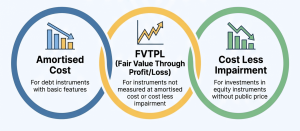
Historically, the standard included a cross-reference that allowed entities to fall back on the recognition and measurement principles of the older IAS 39. The latest edition formally deletes this IAS 39 fallback provision. Now, it reshapes Section 11 to more closely align with IFRS 9’s classification mechanisms. While classification aligns with modern standards, the IASB deliberately shielded SMEs from the highly complex Expected Credit Loss (ECL) impairment model. The IFRS for SMEs standard retains the much simpler ‘incurred loss’ model, ensuring that impairment is only recognized when there is objective evidence of a loss event. Most basic financial instruments continue to be measured strictly at amortized cost using the effective interest rate.
Section 12 (Fair Value Measurement): Centralized framework aligned with IFRS 13 hierarchy
To eliminate fragmentation, the IFRS for SMEs introduced a new, centralized Section 12 dedicated exclusively to fair value measurement, heavily mirroring the IFRS 13 fair value hierarchy. When determining the fair value of an asset or liability, entities must maximize the use of observable inputs. The hierarchy dictates Level 1 inputs as unadjusted quoted prices in active markets, Level 2 inputs as market-corroborated data (such as observable yield curves and implied volatilities), and Level 3 inputs as unobservable, entity-specific data. Same tone as. IFRS 13 Fair Value Measurement.
Section 19 (Business Combinations): Updated ‘business’ definition and contingent consideration rules
Aligned with IFRS 3, the revised Section 19 updates the definition of a ‘business’ to focus firmly on an integrated set of inputs, processes, and resulting outputs that are managed specifically to generate income or return to investors. In terms of purchase price allocation mechanics, the treatment of contingent consideration has been tightened. If contingent consideration is classified as an asset or liability, it must be measured at fair value on the acquisition date, with subsequent changes in fair value recognized in profit or loss.
Core Reporting Modules Breakdown IFRS for SMEs
Balancing compliance and execution, the IFRS for SMEs standard simplifies several core asset measurement modules and radically alters balance sheet capitalization rules compared to the Full IFRS.
Section 17 (PPE): Cost vs. Revaluation models; useful life and residual value adjustments
Under the updated IFRS for SMEs, small and medium-sized businesses measure Property, Plant, and Equipment (PPE) using either the traditional cost method or the revaluation method. If they choose the revaluation model, they must clearly disclose the revaluation surplus and the carrying amount based on historical cost. To avoid unnecessary valuation work, the IFRS for SMEs standard requires management to reassess only the residual value, useful life, and depreciation method of PPE when there is a clear sign of a major change. This is different from Full IFRS, which requires annual reassessment of these factors regardless of any external indicators.
Section 20 (Leases): Dual Operating vs. Finance model mechanics
In a massive departure from the highly capitalized balance sheets under IFRS 16 Leases, Section 20 of the IFRS for SMEs firmly retains the traditional dual-model approach: leases are classified strictly as either operating leases or finance leases.
Finance leases, where substantially all risks and rewards are transferred to the lessee, are capitalized on the statement of financial position. Operating leases, however, remain off-balance-sheet. Payments under operating leases are recognized as an expense on a straight-line basis over the lease term.
Crucially, IFRS for SMEs provides a unique inflation exception. If lease payments are explicitly structured to increase in line with expected general inflation to compensate the lessor’s cost increases, the lessee may recognize the lease expense on a cash basis as incurred. This dual-model retention protects SME balance sheets from massive leverage gross-ups, fundamentally preserving debt-to-equity and EBITDA covenants in commercial loan agreements.
Section 13 (Inventories): FIFO vs. Weighted Average calculations; NRV mechanics
Inventory must be recognized at the lower of cost and estimated selling price less costs to complete and sell, functioning as the Net Realizable Value (NRV) test. When calculating inventory cost outflows, the standard restricts SMEs to using either the First-In, First-Out (FIFO) method or the weighted average cost formula; Last-In, First-Out (LIFO) is absolutely prohibited. For execution efficiency, manufacturing entities are permitted to use standard cost methods or retail inventory methods, provided the resulting valuations closely approximate actual historical cost.
Section 18 (Intangible Assets): Mandatory expensing of research and development
One of the most notable differences dictates the treatment of internally generated intangible assets. Under Section 18, all research and development costs must be recognized immediately as an expense when incurred. The IFRS for SMEs framework completely prohibits capitalizing development costs. This removes the highly subjective and complex Full IFRS requirement for management to constantly assess and document the technical feasibility and commercial viability of R&D projects. Furthermore, all recognized intangible assets, including goodwill, are presumed to have finite useful lives. If management cannot reliably estimate the useful life, the standard enforces a mandatory default amortization period of exactly 10 years.
Execution Strategy: Section 35 First-Time Adoption & Transition Reliefs
The mechanics of transitioning to the IFRS for SMEs framework are governed by Section 35. Transition execution requires strategic planning, as it can fundamentally change the entity’s equity base.
Mechanics of the opening statement of financial position at the transition date
A first-time adopter must prepare an opening statement of financial position as of the transition date (the beginning of the earliest comparative period presented). Management must execute four mechanical steps on this date:
- recognize all assets and liabilities mandated by IFRS for SMEs,
- strictly derecognize items not permitted,
- reclassify legacy items into their correct new categories,
- and apply the standard’s measurement principles universally.
Because these adjustments stem from historical events prior to the transition date, the entire net financial impact must be recognized directly in retained earnings (or another appropriate equity category).
Section 35 retroactive adjustments, mandatory exceptions, and optional exemptions
To prevent impossible retroactive calculations, Section 35 strictly prohibits the retrospective restatement of certain past transactions. An entity cannot retroactively change its accounting for derecognized financial assets, discontinued operations, or old hedging relationships. Furthermore, changes to existing accounting estimates cannot be applied retroactively.
On the other hand, the standard provides powerful optional exemptions that increase execution speed. A vital exemption allows SMEs to use the fair value of an item of property, plant, and equipment at the transition date as its initial deemed cost. This is particularly advantageous for entities holding heavily depreciated but highly valuable real estate, immediately strengthening the balance sheet before reverting to the standard cost model for subsequent measurement.
Transition reliefs for the Latest Edition
For entities adopting the new latest edition updates, specific transition reliefs protect against extensive data mining. Regarding the new Section 23 (Revenue), first-time adopters are granted an exception allowing them to completely bypass the restatement of contracts with customers that were fully completed before the transition date. Additionally, entities are given the flexibility to implement the revised Section 23 either fully retrospectively or purely prospectively, depending on internal data availability.
Global Comparability and Capital Access
Execution of the IFRS for SMEs standard is not merely a compliance exercise; it provides mid-market entities with reporting architecture that speaks the global language of capital.
Framework impact on commercial credit risk assessments and banking relationships
By consistently applying a globally respected, self-contained framework based on IFRS in full, SMEs significantly enhance their financial transparency and data comparability. Commercial banks and global credit rating agencies rely on standardized asset measurement and liability recognition to execute rapid credit risk assessments.
By abandoning highly localized, idiosyncratic national GAAPs in favor of the IFRS for SMEs, entities systematically reduce the information asymmetry between management and lenders. This alignment directly streamlines credit approvals, enhances covenant visibility, and provides access to capital pools from international investors that were historically inaccessible to private entities.
Streamlining cross-border M&A due diligence and scaling for structural exits
For private equity sponsors and multinational corporations, target entities operating on fragmented local accounting standards present immense due diligence risks and integration costs. By executing reporting via the IFRS for SMEs standard, mid-market companies present a normalized, universally readable balance sheet.
Notes from author:
Navigating the transition to IFRS for SMEs or adapting your existing reporting architecture to the latest edition updates requires deep technical expertise. Making incorrect classification decisions, particularly regarding financial instruments, lease accounting, or revenue recognition, can severely affect your balance sheet, leverage ratios, and credit covenants.
If you want to ensure total compliance, protect your banking covenants, or optimize your financial reporting structure for a future exit, let’s talk.
Book a Technical Consultation with Me Today to streamline your transition strategy and ensure your financial statements are robust, compliant, and ready for global growth.